The purpose with the ecocar activities was from the start in 2004 to inspire the students at DTU by letting them work according to the CDIO (Conceive Design Implement Operate) principle. The activities have in the meantime developed from teaching to include also research in development of new engines and powertrains.
DTU Dynamo

Figure 1: DTU Dynamo almost ready to go in Shell Eco Marathon 2007
The DTU Dynamo is an Eco car build by students from Technical University of Denmark. The main purpose with this car is to compete in the yearly eco race Shell Eco Marathon, which students from DTU have done since 2004.
The DTU Dynamo was made in 2005 and has been improved every year since that.
The Dynamo competes in the category Urban Concept Cars with internal combustion engines. In this category there is a strict set of rules that you have to meet, in order to get the car to look like a real car.
For the year 2011 the goal is to improve the car made in 2009, and that way top the result from last year of 348 km/l. To do this the team will try to work with the following improvements.
First of all we are changing fuel from GTL to Ethanol. This means that we will run on a 4-stroke spark ignited engine, unlike previous compression ignited engines. The reason behind this is ethanol’s chemical properties, such as high octane number. Our starting point has been a 50cc 4-stroke engine from a Yamaha Neo’s 4 moped which will be modified in order to get the best fuel economy.
The new engine requires a new gearbox and clutch in order to run as efficient as possible. Previous experiences have shown that a lot of energy is wasted during the acceleration phase due to the high gear ratio and friction loss in the clutch. Therefore our aim this year is to run with a two-speed gearbox with an automatic clutch, which should give us better, more fuel efficient acceleration.
A new shell has been manufactured in order to reduce air resistance. The shell has the same shape as the car from 2009, but it has been made stronger and lighter.
A new set of carbon fiber wheels are under development, which should reduce air flow around the wheels, and therefore improve our fuel economy.
DTU Innovator
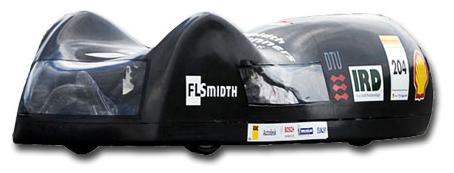
Figure 2: DTU Innovator 2009
Since 2006 the Technical University of Denmark has participated in the Shell Eco Marathon with a fuel cell powered prototype car. Each year a group of engineering students are working on improving the car. All the effort should culminate in a good result at the Shell Eco Marathon in May, where the team competes with students from other European universities. Here we find out whether the work has been successful.
One of the main points of the race is to show the world that means of transportation can be carried out at low energy consumption. One way to accomplish this is by using fuel cells to power the car. Different fuel cells, using different fuels can be applied for generating electricity for the propulsion. The prototype car from DTU uses a hydrogen fuel cell produced by IRD.
The main focuses on the improvements of the car are different every year. Since the design of the car and the aerodynamics are good, and it takes a lot of resources to build a new one, the basic body of the car will remain the same as for the 2011 car.
Towards the race in 2011 the following improvements are to be carried out:
-
Further optimization of the fuel cell
-
Change of the controlling electronics for the fuel cell
-
Configurations of the electrical motors
-
Various other changes, to reduce weight and improve strength of the car
This should improve the DTU record, of 3549km on the energy equivalent to one liter of gasoline, with at least 10%.
For further information see the DTU Roadrunners Ecocar homepage: DTU Ecocar or the official Shell Eco-Marathon homepage: Shell Eco-Marathon